
(Introduction)
In today’s digital era, information and data security has become the most important topic. Every business, institution, and consumer is concerned about data protection. In this context, Blockchain & Data Protection has emerged as a new and effective solution.
Blockchain is an innovative technology that provides a way to store digital information in a secure and transparent manner. Its specialty is that once data is recorded, it is almost impossible to change it, which increases data protection.
In this article, we will take a detailed look at how Blockchain & Data Protection work, what their benefits are, and how they will play an important role in data security in the future.
Basics of Blockchain
What is Blockchain?
Blockchain is basically a digital ledger that stores transactions or data in the form of blocks. Each block contains a unique hash of the data and the hash of the previous block, making the chain of blocks strong and secure.
Important Points:
- Immutable: Once data is recorded, it is almost impossible to change it.
- Decentralized: Data is not held by a single entity but is distributed across the network.
- Transparent: Transactions are clear and verifiable to every participant.
How does Blockchain work?
- Transaction Initiation: When any data or transaction is initiated, it is stored in a block.
- Verification: Other nodes in the network verify the block.
- Hashing: A unique hash is created for each block that links it to the previous block.
- Block Addition: After verification, the block is added to the chain.
Security: Since the hash of each block is linked to the hash of the previous block, any attempt to change a block is immediately detected.
Types of Blockchain
- Public Blockchain: Open to everyone, such as Bitcoin and Ethereum.
- Private Blockchain: Restricted to specific entities, mostly for business purposes.
- Hybrid Blockchain: A combination of Public and Private, where some data is kept open and some is kept private.
The relationship between Blockchain and Data Protection
The connection between Blockchain and Data Protection is more important when it comes to protecting sensitive information. Since data in a blockchain is distributed, immutable, and transparent, it provides protection against information theft, hacking, or unauthorized changes.
For example:
- In the healthcare sector, patient records can be protected.
- Product tracking and data security are improved in the supply chain.
- Financiaal institutions protect their customers’ account data.
The concept of Data Protection and its importance in Blockchain
What is Data Protection?
Data Protection means protecting sensitive information in digital or physical form from unauthorized access, theft, loss, or illegal use. In today’s digital age, every organization and consumer takes steps to protect their data, as data leaks or theft can lead to economic losses, legal issues, and loss of consumer trust.
Important Points:
- Confidentiality: Data should be available only to authorized persons.
- Integrity: Data should not be subject to unauthorized changes.
- Availability: Data should always be available to authorized persons.
Difference between Data Privacy and Security
- Data Privacy: The protection of users’ personal information and the control over its use.
- Data Security: The technical and practical measures that protect data from unauthorized access and loss.
- Blockchain plays a crucial role in both, as it not only secures data but also gives users control over its use.
Legal and ethical aspects
There are Data Protection laws in different countries of the world, such as:
- GDPR (General Data Protection Regulation) in Europe
- Various state laws in the US
- Local laws in other countries
Blockchain & Data Protection helps in securing data in accordance with these laws, because its technology:
- Makes data immutable.
- Keeps transparent records.
- Gives the user control over their data.
The importance of data protection in Blockchain
The connection between Blockchain & Data Protection becomes more apparent when it comes to protecting sensitive or personal information.
Immutable Ledger
Once data is recorded in the blockchain, it is almost impossible to change or delete it, which ensures data security.
Decentralization
Data is not stored on a single server, but is distributed across the network. This reduces the chances of hacking or data theft.
Cryptography
Data in the blockchain is protected by encryption, allowing only authorized individuals to read or use it.
Transparency and Accountability
Every transaction is recorded and verifiable to all network participants, allowing any illegal or suspicious activity to be immediately identified.
Reel-Life Champlays
- Financial sector: Customers’ bank accounts and transactions are protected.
- Healthcare sector: Patients’ medical records are protected from unauthorized access.
- Supply chain: Accurate tracking and quality verification of products is possible.
Technical Features of Blockchain and Its Role in Data Protection
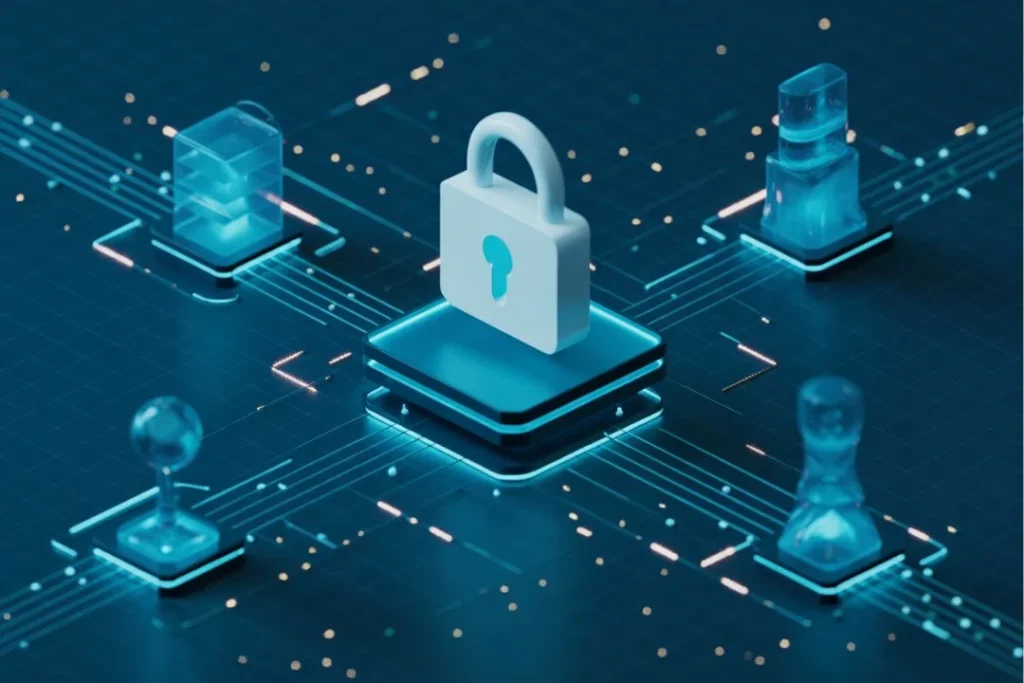
Technical Features of Blockchain
To understand the relationship between Blockchain & Data Protection, it is first important to understand the technical characteristics of Blockchain. These characteristics make it unique and effective for data protection.
Cryptography and Encryption
Cryptography is the most important pillar of blockchain. It protects data in such a way that only authorized individuals can read or use it.
Hash functions:
The data in each block is converted into a unique hash. This hash changes immediately upon any small change to the data, ensuring data integrity.
Public Key and Private Key:
Users have a private key and a public key. The private key is used to access data or verify transactions, while the public key is used to verify information for other people.
Nachdripatnam:
Data is protected by encryption so that unauthorized people cannot read it. This makes both Blockchain & Data Protection possible.
Consensus mechanisms
Consensus Mechanism is the process of data verification and network security in blockchain.
Proof of Work (PoW):
This method verifies the block through hashing. Only after solving complex problems is the block added to the blockchain.
Proof of Stake (POS):
In this, an investment (stake) is made in the network for verification, and nodes with more stake get the right to verify.
Delegated Proof of Stake (DPoS) and others:
Various blockchain projects have used improved versions of PoW and PoS to increase both security and speed.
These mechanisms ensure that no unauthorized or fraudulent person can join the blockchain, which is very important for data protection.
Smart Contracts and Data Protection
Smart Contracts are automated programs that run based on rules and conditions that are stored on the blockchain.
- They automate user data and transactions in a secure manner.
- They immediately stop illegal or suspicious activity.
- Blockchain & Data Protection is important because it maintains data integrity and privacy.
Decentralization and Distributed Ledger
Decentralization is the core concept of blockchain. In this, data is distributed across the entire network, not on a single central server.
- If a node is hacked, the entire network is not affected.
- Every piece of data remains consistent and secure.
Distributed Ledger maintains a single record on each node, which ensures Transparency and Accountability.
Benefits in Blockchain & Data Protection
Benefits in Blockchain & Data Protection
These technical features of Blockchain are helpful in Data Protection in many ways:
- Immutable Ledger: Data is immutable.
- Security: Data remains secure due to Cryptography and Consensus Mechanisms.
- Transparency: Every transaction is clear to all participants in the network.
- User Control: The user gets complete control over their data.
- Auditability: Full tracking of every change or transaction is possible, which is useful for legal and commercial needs.
Real-life usage examples
- Financial sector: Through blockchain, bank customers’ accounts and transactions remain secure, and the possibility of fraud is reduced.
- Healthcare sector: Patient records can be stored on blockchain, where only authorized doctors or institutions can view them.
- Supply chain: Tracking of every step of the product from production to sale is possible, which maintains quality and authenticity.
Blockchain & Data Protection: FAQs
What is Blockchain & Data Protection?
Blockchain & Data Protection is a system that uses blockchain technology to store data in a secure and transparent manner. In this, data remains immutable, secure, and under the control of the user, which makes data protection possible.
How does Blockchain help in Data Protection?
- Blockchain protects data in several ways:
- Data cannot be changed once recorded (Immutable Ledger)
- Data is distributed across the network (Decentralization), which reduces the chances of hacking
- Data is protected from unauthorized access through Cryptography and Encryption
- Transparency and Auditability make it possible to verify every transaction
What is the difference between Blockchain and Traditional Data Storage?
- In traditional data storage, data is often stored on a central server or institution, which is more vulnerable to hacking or data loss.
- In blockchain, data is distributed across the network, immutable, and transparently stored.
What features of Blockchain are important for data protection?
- Immutable Ledger – Prevents unauthorized alteration of data
- Decentralization – Reduces the chances of hacking
- Cryptography & Encryption – Makes data accessible only to authorized persons
- Smart Contracts – Enables automated and secure data processing
- Transparency & Auditability – Verify records according to legal and commercial standards
Is Blockchain safe for all types of data?
- Blockchain is safe for most sensitive and important data, but there are some challenges:
- Scalability issues for large databases
- High energy consumption in some blockchain networks
- Need for additional mechanisms to comply with legal and privacy laws
Where is Blockchain used?
- Financial sector: Banking and cryptocurrency transactions
- Health sector: Patient records and medical data
- Supply chain: Product tracking and quality assurance
- Legal sector: Contracts and property records
How will Blockchain & Data Protection evolve in the future?
- Blockchain integration with Artificial Intelligence
- A more scalable and energy-efficient blockchain network
- Better privacy controls for users
- Full compliance with legal and regulatory frameworks
Is Blockchain only for digital currency?
No, although Blockchain was first used in Bitcoin and other cryptocurrencies, today it is also widely used in healthcare, finance, supply chain, educational records, and legal sectors.
How is Data Privacy ensured in Blockchain?
- Through Encryption and Cryptography
- Through User Data Access Permissions
- Automatic Protection Through Smart Contracts
- Protection from Unauthorized Access Thanks to Decentralized Ledger
What is the biggest advantage of Blockchain & Data Protection?
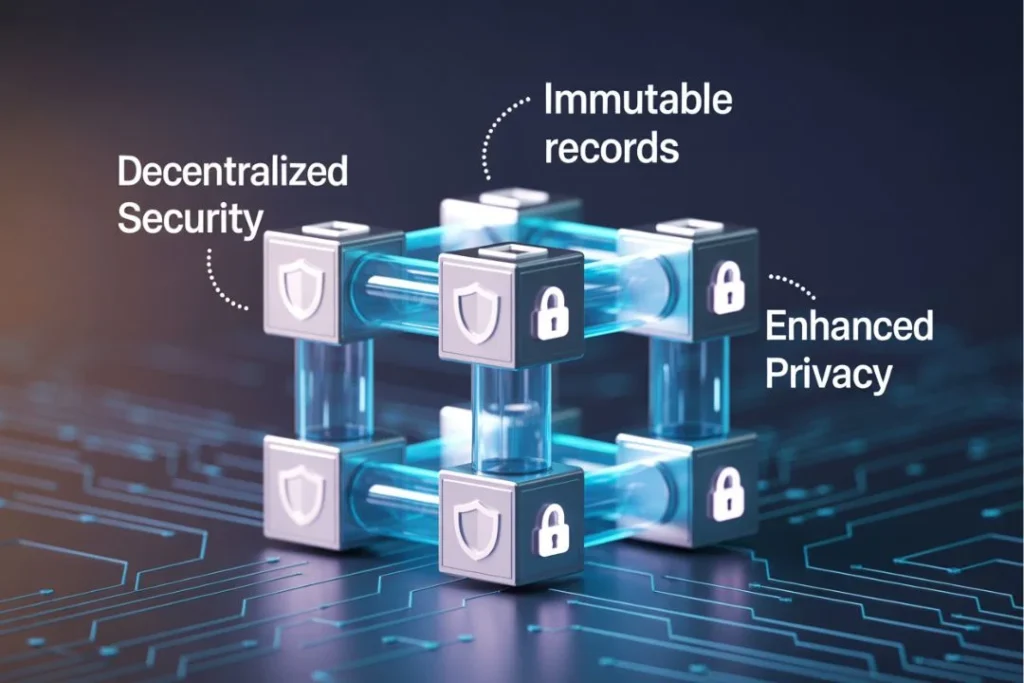
The biggest benefit is that it makes data secure, transparent, and immutable, which increases business trust, meets legal requirements, and keeps customer data safe.
(Conclusion)
Blockchain & Data Protection is a very important and effective solution for information security and transparency in today’s digital era. Blockchain’s features like Immutable Ledger, Decentralization, Cryptography, and Smart Contracts make it not only secure but also trustworthy according to legal and commercial standards.
Given the increasing risks of data theft, hacking, or illegal use, Blockchain & Data Protection has become an essential technology for sectors such as businesses, the financial sector, the healthcare sector, and supply chains. It not only protects data but also provides users with control and transparency over their data, which is a guarantee of trust and quality.
Blockchain & Data Protection will continue to evolve in the future, where Artificial Intelligence, legal regulations, and modern technical updates will make this technology more secure, faster, and more user-friendly.
In conclusion, it can be said that if an organization or user wants to ensure the security, transparency, and legal compliance of their data, Blockchain & Data Protection is the best solution both today and in the future.