In modern software development, security is no longer something organizations can afford to consider only before releasing an application. As development teams adopt cloud technologies, automated deployment pipelines, and continuous delivery practices, the need to identify and manage security risks throughout the software lifecycle has become increasingly important.
Two approaches that help organizations achieve this goal are shift-left security and shift-right security. Although both aim to improve application security, they focus on different stages of the development process.
Shift-left security emphasizes identifying vulnerabilities early, often during planning, coding, and testing. Shift-right security focuses on protecting applications after deployment through continuous monitoring, runtime protection, threat detection, and incident response.
For a long time, organizations concentrated heavily on pre-release security testing. However, discovering vulnerabilities before deployment does not guarantee that an application will remain secure in production. New threats, unexpected user behavior, configuration changes, and previously unknown vulnerabilities can introduce risks after release.
This is why modern DevSecOps teams need to understand both approaches and learn how to combine them effectively.
Rather than choosing shift-left or shift-right security, organizations should establish a balanced strategy that prevents avoidable vulnerabilities early while maintaining the ability to detect and respond to threats in live environments.
1. Understanding Shift-Left Security
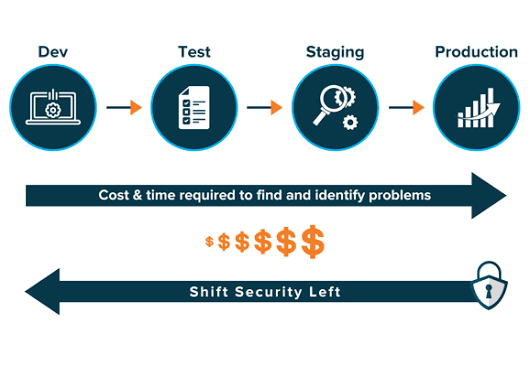
Shift-left security is an approach that moves security activities earlier in the software development lifecycle. Instead of waiting until an application is nearly ready for release, teams identify and address potential weaknesses during planning, design, coding, and initial testing.
The main idea is straightforward: finding a vulnerability early often makes it easier and less expensive to resolve.
For example, imagine a developer building an application that processes customer information. If the team identifies an authorization weakness during the design stage, it can correct the architecture before the application becomes dependent on insecure behavior.
If the same issue is discovered after deployment, the organization may need to modify application logic, update infrastructure, coordinate a release, and investigate whether customer data was exposed.
Shift-left security reduces these risks by integrating security checks into everyday development workflows.
Common shift-left practices include:
- Threat modeling during application design.
- Secure coding guidelines and developer training.
- Static Application Security Testing (SAST).
- Software Composition Analysis (SCA) for third-party dependencies.
- Secret scanning in source code repositories.
- Infrastructure as Code security checks.
- Automated security testing during continuous integration.
These activities help developers identify vulnerabilities while changes are still relatively easy to modify.
However, shift-left security does not mean that every security decision must be made before coding begins. It means introducing appropriate security measures as early as practical and continuing them throughout development.
2. Understanding Shift-Right Security
Shift-right security focuses on identifying and managing security risks after software has been deployed.
Even when an application passes pre-release testing, its production environment may reveal problems that were not visible during development. Real users behave differently from test users, infrastructure changes over time, and attackers may discover weaknesses that automated tests did not identify.
Shift-right security addresses these challenges by observing application behavior, detecting suspicious activity, and responding to emerging threats.
For example, a web application may pass every planned security test but later experience unusual login attempts from multiple locations. Runtime monitoring can help identify the suspicious activity, while an incident response process enables the security team to investigate and contain the threat.
Common shift-right security practices include:
- Runtime Application Self-Protection (RASP), where appropriate.
- Web Application Firewall (WAF) protection.
- Cloud security monitoring.
- Security Information and Event Management (SIEM).
- Runtime threat detection.
- Vulnerability monitoring and patch management.
- Production penetration testing and security assessments.
- Incident response and forensic investigation.
These practices provide visibility into how applications behave under real-world conditions.
Shift-right security also supports continuous improvement. Production incidents, monitoring alerts, and customer reports can reveal weaknesses that development teams should address in future releases.
The objective is not simply to react when an attack occurs. It is to maintain awareness of production risks and reduce the time needed to detect, investigate, and resolve security problems.
3. Key Differences Between Shift-Left and Shift-Right Security
Although shift-left and shift-right security support the same overall goal, they differ in their primary focus, timing, and methods.
| Aspect | Shift-Left Security | Shift-Right Security |
|---|---|---|
| Primary focus | Preventing vulnerabilities early | Detecting and managing risks in production |
| Main stages | Planning, coding, building, and testing | Deployment, operation, and maintenance |
| Typical tools | SAST, SCA, secret scanning, IaC scanning | SIEM, WAF, runtime monitoring, threat detection |
| Main advantage | Finds many issues before release | Identifies threats and unexpected behavior in real environments |
| Main limitation | Cannot predict every production threat | Often detects issues after exposure has begun |
| Feedback source | Code analysis, design reviews, and security tests | Runtime activity, alerts, incidents, and production telemetry |
| Typical outcome | Fewer preventable weaknesses reach production | Faster threat detection and better incident response |
These differences show why neither approach can replace the other.
Shift-left security helps reduce the number of vulnerabilities introduced into an application. Shift-right security helps organizations understand and manage the risks that remain after deployment.
Together, they provide broader protection across the software lifecycle.
4. Why Shift-Left Security Matters in Modern Development
One of the biggest advantages of shift-left security is the opportunity to resolve problems before they become expensive operational issues.
When security is introduced early, developers can incorporate appropriate protections directly into the application’s architecture and implementation.
For example, a design review might identify that an application needs stronger authorization checks between different customer accounts. Addressing the requirement early is generally easier than retrofitting the entire authorization model after launch.
Shift-left security also supports faster development when implemented thoughtfully. Automated checks can provide immediate feedback, allowing developers to correct mistakes without waiting for a separate security review.
Another benefit is improved developer awareness. When developers regularly work with secure coding practices and receive useful feedback from security tools, they become better equipped to recognize common vulnerabilities.
However, organizations must avoid turning shift-left security into an overwhelming collection of mandatory checks.
If every minor finding blocks a build, developers may experience unnecessary delays and begin treating security tools as obstacles. False positives and poorly explained alerts can also reduce trust in automated testing.
To avoid these problems, teams should prioritize findings based on risk, provide clear remediation guidance, and make security checks part of the normal development workflow.
The most successful shift-left programs help developers make secure decisions rather than simply generating more security reports.
5. Why Shift-Right Security Is Equally Important
No matter how carefully software is developed, pre-release testing cannot identify every possible vulnerability or attack scenario.
Applications operate in environments that change continuously. New dependencies become vulnerable, cloud permissions may be modified, credentials can be compromised, and attackers may discover new ways to exploit legitimate functionality.
Shift-right security helps organizations respond to these realities.
Continuous monitoring can reveal suspicious authentication attempts, unusual network activity, unexpected privilege changes, or abnormal application behavior. These signals may indicate an attack or an operational weakness that requires investigation.
For example, a company may deploy an application with appropriate authentication and authorization controls. Months later, a newly discovered vulnerability in a third-party component may affect the application.
Runtime monitoring and vulnerability intelligence can help the organization assess exposure, prioritize remediation, and determine whether additional protective measures are necessary while a permanent fix is prepared.
Shift-right security also provides evidence that cannot always be obtained through pre-release testing. Production logs, actual traffic patterns, and real incident data can reveal how applications behave under genuine operating conditions.
This information helps teams improve their security controls and make better decisions about future releases.
Without shift-right security, organizations may have limited visibility into what happens after deployment, leaving them dependent on assumptions made during testing.
6. The Risks of Relying Only on Shift-Left Security
Shift-left security provides valuable protection, but relying on it exclusively creates several gaps.
First, automated testing tools cannot detect every vulnerability. SAST tools may miss weaknesses that depend on complex application behavior, while dependency scanners cannot identify every possible supply chain compromise.
Second, test environments rarely reproduce every condition found in production. Differences in infrastructure, network configuration, user behavior, and third-party integrations can expose problems that were not apparent earlier.
Third, new threats emerge after deployment. A software component that was considered safe during testing may later receive a critical security advisory.
Consider an application that passes its security tests and is deployed successfully. If an attacker subsequently steals a privileged account, the application may still be exposed even though its original code was tested carefully.
Production monitoring, identity controls, and incident response capabilities are needed to detect and manage such events.
Organizations that rely only on shift-left security may also develop a false sense of confidence, assuming that passing security checks means an application is completely secure.
The better approach is to treat pre-release testing as an important layer of defense, not as proof that all security risks have been eliminated.
7. The Risks of Relying Only on Shift-Right Security
Focusing exclusively on shift-right security creates a different set of problems.
Runtime monitoring can detect suspicious behavior, but it does not eliminate the underlying vulnerabilities that make attacks possible.
If an application contains an insecure authorization mechanism, for example, a monitoring system might identify unusual access patterns. However, the organization may still need to correct the application code to prevent unauthorized access.
Waiting until vulnerabilities appear in production can also increase remediation costs and business risk.
Fixing an architectural weakness after deployment may require emergency development work, coordinated releases, customer communication, and additional investigation to determine whether an incident occurred.
Furthermore, not every attack produces an obvious signal. Sophisticated attackers may attempt to avoid detection, and monitoring systems can generate false positives or miss certain activities entirely.
Runtime protection should therefore not be treated as a substitute for secure design, code review, or vulnerability testing.
Organizations need preventive controls that reduce the likelihood of compromise, along with detection and response capabilities that address threats that remain.
8. How to Balance Shift-Left and Shift-Right Security in DevSecOps
The best DevSecOps strategy connects early prevention with continuous production protection.
Rather than operating separate security programs, organizations should create a feedback loop in which development and production security activities inform each other.
A practical approach includes the following steps.
Step 1: Establish security requirements early
Identify sensitive data, important business functions, potential attack paths, and relevant compliance requirements during planning.
Use threat modeling and security-focused design reviews to identify risks before they become deeply embedded in the application.
Step 2: Automate appropriate pre-release checks
Integrate code scanning, dependency analysis, secret detection, and infrastructure configuration checks into the CI/CD pipeline.
Prioritize findings according to severity, exploitability, and business impact instead of blocking releases for every low-risk alert.
Step 3: Verify the security of release artifacts
Restrict access to build infrastructure, verify artifact integrity, and maintain appropriate controls over the process that produces deployable software.
Ensure that the artifact approved for release is the one that reaches production.
Step 4: Monitor production continuously
Collect relevant security logs, monitor application and infrastructure behavior, and establish alerting rules for suspicious activities.
Make sure alerts have clear ownership and can trigger appropriate investigation and response procedures.
Step 5: Feed production findings back into development
Use information from incidents, runtime alerts, and vulnerability assessments to improve code, tests, architecture, and deployment configurations.
For example, if a production incident reveals a missing authorization check, developers can fix the issue and add automated tests that help prevent the same weakness from returning.
Step 6: Review and improve the entire process
Regularly assess whether security controls are effective, whether teams can resolve findings efficiently, and whether production incidents are leading to meaningful improvements.
This approach allows organizations to strengthen security over time without treating development and operations as separate worlds.
9. Integrate Shift-Left and Shift-Right Into the CI/CD Pipeline
A well-designed CI/CD pipeline can connect security activities across multiple stages of software delivery.
During planning, teams identify risks and define security requirements. During coding, they use secure development practices, peer reviews, and secret scanning.
During continuous integration, automated tools assess code quality, dependencies, and infrastructure definitions. Before release, teams perform appropriate application testing and verify that artifacts meet security requirements.
After deployment, runtime monitoring, vulnerability management, and incident response help protect the application in production.
A simplified example of this process looks like this:
<box border radius=”lg” padding={3} gap={2}> <box background=”surface-secondary” radius=”md” padding={3} align=”center” gap={1}> <title size=”md”>1. Plan and Design</title> <text textAlign=”center” size=”sm”>Threat modeling, security requirements, architecture reviews</text> <badge color=”info”>Shift left</badge> </box> <row justify=”center”> <icon name=”arrow-down” size=”lg” color=”secondary”/> </row> <box background=”surface-secondary” radius=”md” padding={3} align=”center” gap={1}> <title size=”md”>2. Code and Build</title> <text textAlign=”center” size=”sm”>SAST, dependency scanning, secret detection, secure builds</text> <badge color=”info”>Shift left</badge> </box> <row justify=”center”> <icon name=”arrow-down” size=”lg” color=”secondary”/> </row> <box background=”surface-secondary” radius=”md” padding={3} align=”center” gap={1}> <title size=”md”>3. Test and Release</title> <text textAlign=”center” size=”sm”>Security testing, artifact verification, deployment policies</text> <text size=”sm” weight=”medium”>Pre-release protection</text> </box> <row justify=”center”> <icon name=”arrow-down” size=”lg” color=”secondary”/> </row> <box background=”surface-secondary” radius=”md” padding={3} align=”center” gap={1}> <title size=”md”>4. Deploy and Monitor</title> <text textAlign=”center” size=”sm”>Runtime monitoring, threat detection, incident response</text> <badge color=”success”>Shift right</badge> </box> <row justify=”center”> <icon name=”arrow-down” size=”lg” color=”secondary”/> </row> <box border radius=”md” padding={3} align=”center” gap={1}> <title size=”md”>5. Learn and Improve</title> <text textAlign=”center” size=”sm”>Use production findings to improve code, tests, and security controls</text> <text color=”secondary” size=”sm”>Continuous feedback into development</text> </box> </box>
The exact controls will depend on the application, technology stack, and business risk. A small internal application may need a different level of assurance from a payment platform or a system handling highly sensitive information.
The important point is that security activities should complement one another and provide feedback throughout the lifecycle.
10. Use Production Insights to Improve Early Security Testing
One of the greatest advantages of combining shift-left and shift-right security is the ability to learn from production experience.
Security teams often discover useful information through runtime alerts, customer reports, penetration tests, and incident investigations. These findings can reveal gaps in automated tests or assumptions made during application design.
Instead of fixing the immediate problem and moving on, teams should examine whether the development process can be improved to prevent similar issues.
For example, if production monitoring identifies an authorization weakness, the response should include correcting the vulnerability and adding tests that verify access restrictions for different user roles.
If an incident involves an exposed credential, the organization may introduce stronger secret scanning, improve credential handling, or change pipeline permissions.
If runtime monitoring reveals repeated attempts to exploit a particular application endpoint, developers may review the relevant code and strengthen input validation, rate limiting, or other appropriate protections.
This feedback loop helps teams turn operational experience into preventive improvements.
Over time, the combination of production insights and early testing can reduce recurring vulnerabilities and improve the effectiveness of security controls.
11. Choose the Right Security Tools for Each Approach
Security tools should support the organization’s overall risk management strategy rather than determine it.
Shift-left security typically relies on tools that examine code, dependencies, infrastructure definitions, and application behavior before release.
Shift-right security often uses tools that monitor running applications, analyze logs, detect suspicious activity, and support incident response.
The following examples illustrate how these capabilities complement each other.
| Security need | Shift-left examples | Shift-right examples |
|---|---|---|
| Application security | SAST and security-focused code reviews | Runtime monitoring and application attack detection |
| Dependency risk | SCA and dependency policy checks | Monitoring vulnerability advisories and assessing deployed exposure |
| Cloud security | Infrastructure as Code scanning | Cloud security posture monitoring and runtime threat detection |
| Credential protection | Secret scanning and secure credential injection | Monitoring unusual credential use and suspicious authentication |
| Release integrity | Build verification and artifact signing | Monitoring deployment changes and unexpected production modifications |
| Vulnerability management | Pre-release testing and remediation workflows | Production exposure assessment, patch prioritization, and incident response |
Organizations should evaluate tools based on coverage, integration, accuracy, usability, and the quality of their findings.
It is usually more effective to build a manageable set of well-integrated controls than to deploy many overlapping tools that generate large volumes of duplicate alerts.
Tools also require ongoing maintenance. Security rules, integrations, and policies should be updated as the development environment and threat landscape change.
12. Measure the Effectiveness of Both Approaches
To find the right balance between shift-left and shift-right security, organizations need metrics that show whether their combined strategy is reducing risk.
For shift-left security, useful measurements include the time required to resolve vulnerabilities, the number of recurring coding weaknesses, the percentage of repositories covered by security checks, and the number of serious issues discovered before release.
For shift-right security, teams can measure detection time, incident response time, the duration of production exposure, and the effectiveness of remediation after vulnerabilities are identified.
Organizations should also evaluate how often production incidents reveal gaps in pre-release testing.
For example, repeated incidents involving the same type of authorization weakness may indicate that security requirements, code reviews, or automated tests need improvement.
However, metrics should be interpreted in context. A rise in detected vulnerabilities may reflect better scanning coverage, while a low number of alerts may simply mean that monitoring is incomplete.
The purpose of measurement is to identify weaknesses and improve the security process, not to reward teams for reporting fewer problems.
By reviewing these indicators regularly, organizations can determine whether their preventive and detective controls are working together effectively.
13. Common Mistakes to Avoid When Balancing Security
Even organizations that understand both approaches can struggle to implement them effectively.
One common mistake is treating shift-left security as a checklist. Running a scanner during development does not guarantee that findings are reviewed, prioritized, or resolved.
Another mistake is assuming that production monitoring can compensate for weak application design. Detecting suspicious behavior is valuable, but prevention remains essential.
Teams may also create unnecessary friction by introducing too many mandatory checks without considering risk or developer workflow. Excessive alerts can reduce confidence in security tooling and delay legitimate releases.
Poor communication between development, security, and operations teams can create another gap. If production findings are not shared with developers, recurring vulnerabilities may remain unaddressed.
Finally, organizations sometimes focus on tools rather than outcomes. Purchasing a new security platform will not automatically improve security if teams lack clear responsibilities, remediation processes, and incident response plans.
Avoiding these mistakes requires a practical strategy built around risk, collaboration, and continuous improvement.
Conclusion
Shift-left security and shift-right security serve different but equally important purposes in modern DevSecOps.
Shift-left security helps organizations identify vulnerabilities early, improve secure coding practices, and reduce the cost of remediation. Shift-right security provides visibility into production environments, helps detect emerging threats, and supports rapid incident response.
Neither approach can provide complete protection on its own. Early testing cannot predict every production threat, while runtime monitoring cannot eliminate the weaknesses that make attacks possible.
The most effective strategy combines both approaches through a continuous feedback loop. Security requirements guide development, automated testing identifies preventable weaknesses, controlled deployments protect release integrity, and production monitoring reveals risks that require further investigation.
Organizations should begin with controls that address their most important risks, integrate those controls into existing workflows, and use real-world findings to improve future releases.
Ultimately, finding the right balance is not about deciding whether security should happen before or after deployment. It is about recognizing that security must be present throughout the entire software lifecycle.
When prevention, detection, and response work together, DevSecOps teams can deliver software more confidently, respond to threats more effectively, and build stronger security practices without sacrificing the speed of modern development.